I knew a guy who related well to the widest array of people. But he never took a stand on anything. He told me, “I like to err on the side of grace.” Sounded noble, but sometimes it was a dodge. He built beautiful bridges but did not cross them, afraid the weight of his conviction might shiver the timbers.
I get the impulse. Working with people feels fragile sometimes and is full of conflict. Disagreeing agreeably requires at least one person to stay calm.
But we can do more than just slow the conversation down. We can learn to understand why we disagree in the first place.
Becoming aware of your assumptions
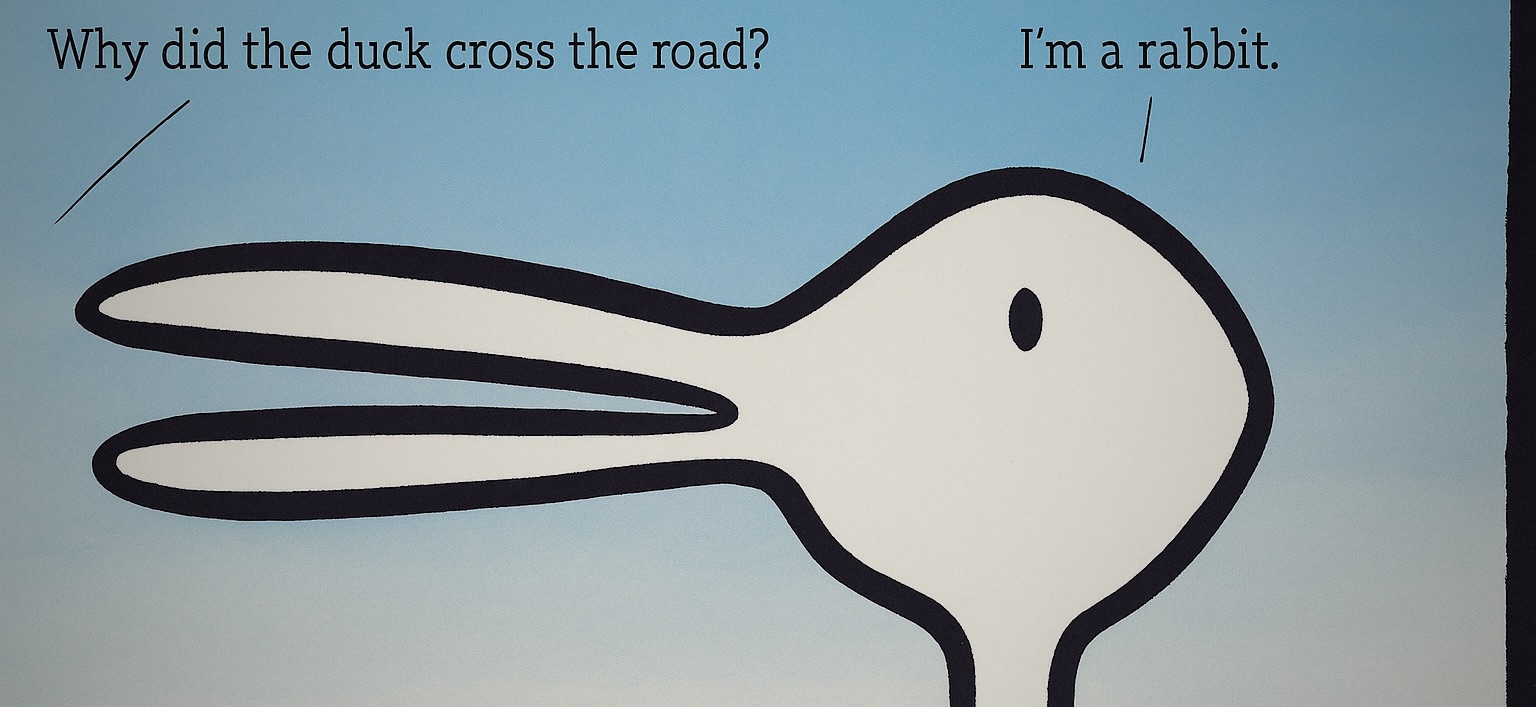
The picture above can be seen two ways. Same lines, same pixels—one data set.
Half the room will see a duck, and the other half, a rabbit—two conclusions.
Why? Because we bring two sets of assumptions.
Until we name those assumptions, we argue endlessly about conclusions that were baked in from the start.
We talk past each other until we name them.
Columnist David Brooks names one assumption in a recent New York Times article. He points out that materialism—a common worldview on the political left—assumes money is the master lever for solving problems. Yet, as he notes, that view often overlooks the stubborn influence of culture. More funds don’t help kids read when their homes and neighborhoods are chaotic. Cash can’t replace culture.
A parenting illustration
Some anxious onlookers can’t see past their own feelings when it comes to social problems. They assume anyone who talks about culture just doesn’t care about people in need. But it’s not callousness—it’s a different way of seeing. The “fix-it-now” crowd sees a duck, not a rabbit—a problem to solve right away, not a pattern to understand.
My mom saw this principle as a nurse on a pediatric cancer floor at Duke. She assisted with spinal taps for children needing a diagnosis. One boy’s mother told her, “I don’t know how you do it. I just love children too much.” No—she loved herself too much. Love wills the good of someone else even when it’s uncomfortable to you. A good parent values a child’s present feelings and their future need.
In ministry we call this “helpful help.” The opposite, is harmful help, what a mentor of mine, Bob Lupton, calls Toxic Charity. Some aid soothes the giver but weakens the receiver. The goal is relief that leads to development, belonging, and responsibility—care that actually heals.
Based on what?
Social psychologist Jonathan Haidt explains how hidden assumptions shape our view of things. In his book The Righteous Mind he says moral foundations are a gut-level response to an issue. He lists them as— care/harm, fairness/cheating, loyalty/betrayal, authority/subversion, sanctity/degradation and liberty/oppression).
Progressives tend to emphasize care/harm. Conservatives tend to distribute weight across all the foundations. As a result of these different hidden foundations, the same problem can lead two people to two different animals. Different conclusions.
Not that all conclusions are valid. It just means it’s possible to find common ground rather than just reacting to someone’s stance.
How do we find conversational common ground?
1. Name assumptions.
Why do you see the duck or the rabbit? Someone said, “You take a stand from where you sit.” Do you sit on the assumption that human nature is basically good? Then you will stand for compassion alone (i.e. more cash). Do you sit on the assumption that people can’t change? Then you’ll stand only for accountability (i.e. more prisons). When the premise stays hidden, policy talk is a shell game.
2. Rank values.
I used to scratch my head about people’s passion for abortion as birth control. Then I started to see what was driving it. They want life to be more fair for young girls caught in a cycle of poverty. That connection at least keeps me from reacting. It does not excuse the practice. But it can help me bring in the value of the sacred that is missing on their side. To explain how two lives are at stake, not just one.
3. Defend your ideas, not yourself.
Simon Sinek tells a story about an actor who played a villain. After the premiere, a reporter asked how he understood evil so well. The actor looked puzzled. “I didn’t study evil,” he said. “I studied me.” He tapped into his own human condition to understand the role.
Christians should feel this. When we stand against evil but sound like we’re the source of the good, persuasion dies at hello. It’s the Pharisee’s prayer in fresh clothes: “I’m glad I’m better than you.” That isn’t the Gospel. Paul boasted in weakness because he wanted a power beyond him to factor in. He kept pointing beyond himself—trusting grace to be at work.
G.K. Chesterton said,
What we suffer from today is humility in the wrong place. Modesty has moved from the organ of ambition and settled upon the organ of conviction, where it was never meant to be. A man was meant to be doubtful about himself, but undoubting about the truth; this has been exactly reversed. We are on the road to producing a race of men too mentally modest to believe in the multiplication table.
In the heat of the moment how does this background help us we win people and not just arguments? We can become more confident without superiority. Because when you’re squeezed, what’s in there will come out.
“Whoever restrains his words has knowledge, and he who has a cool spirit is a man of understanding. Even a fool who keeps silent is considered wise. – Proverbs 17:27–28

Leave a Reply